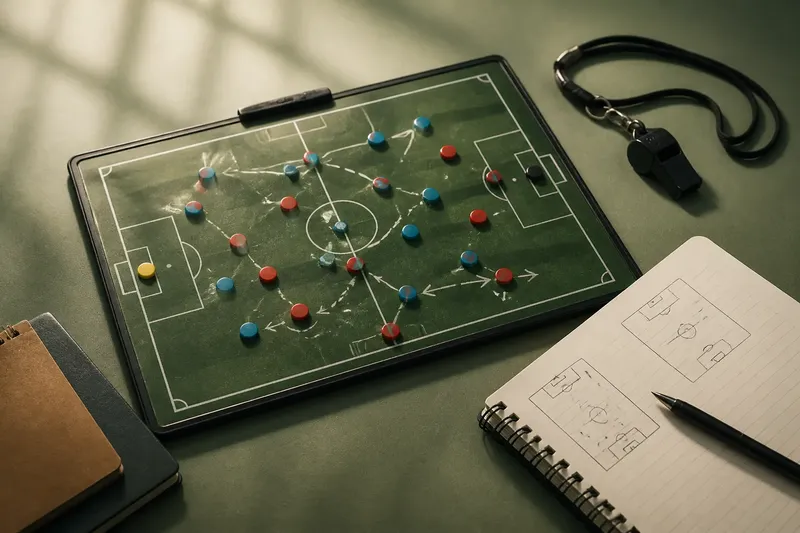
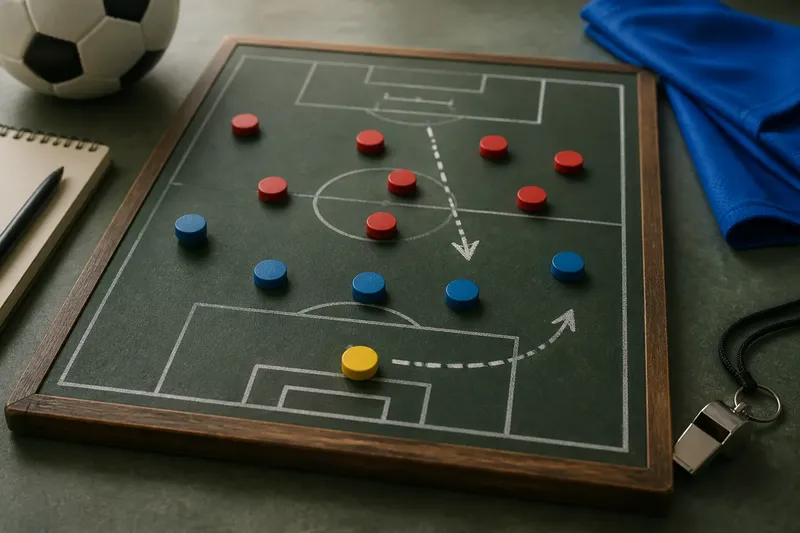
Wide or Narrow: How Attacking Shape Changes the Space
Wide or narrow attacking shape changes where a defence must move; learn to spot the open lane, the isolated player and the safer next pass.
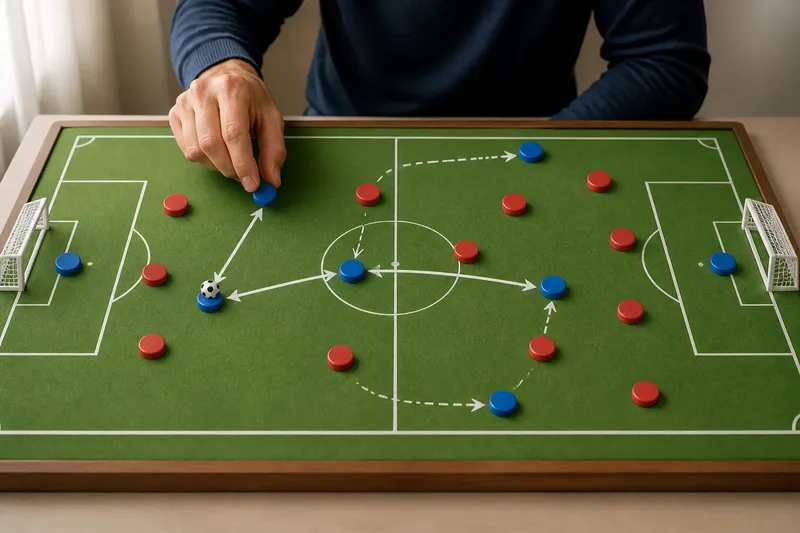
Wide or narrow attacking shape changes which spaces a defence has to protect. Watch where the defenders are pulled: a team holding the touchlines can stretch the back line, while one crowding a channel can occupy several markers and open space elsewhere.
Imagine a fictional side, Harbour, facing fictional opponents, Vale. Vale’s back line is compact, and its midfield sits close enough to block passes through the centre. Harbour’s choice is not simply between crossing and short passing. It is whether to make Vale defend the full width of the pitch or commit numbers to a particular lane—and how to exploit the space that choice leaves.
Width tests how far Vale will follow its markers
Harbour starts with one winger close to each touchline. Vale’s full-backs must decide whether to move out with them or stay nearer the centre-backs. If a full-back follows the winger wide, a channel may open inside. If the full-back holds position, the winger may receive with more room to turn.
That outside position also gives Harbour a reference point for switches of play. When Vale shifts towards one flank, a pass across the pitch can reach the far winger away from the densest pressure. The switch is useful only if the ball-carrier has time and a clear passing lane; a wide receiver who is already pinned against the touchline may have little room to act.
Width can therefore stretch the defence without producing an immediate attack. Harbour should notice whether Vale’s line has become longer, whether a defender has been drawn away from a teammate, and whether the far side remains available. If none of those changes, simply keeping both wingers wide may leave them isolated.
Narrow positioning overloads a lane rather than the whole pitch
Harbour can instead move one winger into the inside channel, close to the central midfielder and forward. This makes several passing options available around one part of Vale’s defence. The aim is not merely to make passes shorter: it is to make a defender choose whom to track, then use the space created by that choice.
If Vale’s full-back follows the winger inside, Harbour may find room outside for an advancing teammate. If the full-back stays wide, the winger may receive between the lines. A nearby midfielder can support the ball, but should not occupy the same patch of ground as the winger; staggered positions give one player a short option and another a route forward.
The trade-off is local congestion. When several Harbour players gather in the same channel, Vale can crowd them out and the far side may become difficult to reach. Harbour needs a player positioned to carry or pass away from pressure, as well as cover behind the attack in case Vale wins the ball.
Choose width or narrow support by reading the defender’s movement
Harbour should judge the shape by the defensive response, not by the nominal position of its wingers. A useful adjustment changes a defender’s assignment, opens a route for a teammate or gives the ball-carrier a safer next action. If the same player still receives under pressure with no support, the problem has not changed.
- Check whether Vale’s full-back follows a winger towards the touchline; if so, look for a pass into the channel behind that defender, otherwise keep the winger available to receive outside.
- Check whether Vale’s midfield shifts towards Harbour’s narrow group; if so, switch to the far side, otherwise look for a forward pass through the central lane.
- Check whether the ball-carrier has a nearby teammate facing forward; if so, use the combination to advance, otherwise recycle the ball rather than force a pass into pressure.
- Check whether two Harbour players are occupying the same lane and depth; if so, move one wider or beyond the line, otherwise keep their staggered positions to offer distinct passes.
- Check whether Vale has left the far winger free but the passing lane is blocked; if so, move the ball through a supporting player before switching, otherwise play across while the receiver can face forward.
- Check whether Harbour has cover behind an advancing full-back; if so, continue the attack with that protection in place, otherwise hold the full-back back or delay the forward run.
How can you tell which attacking shape is working?
What does width change for the defending team?
It asks defenders to cover more lateral space and can draw a full-back away from the centre. Watch whether that movement gives a teammate a usable lane, rather than treating a winger’s position on the touchline as success by itself.
Why move a winger into an inside channel?
An inside position can bring the winger close enough to combine and make a defender choose between tracking them and protecting the outside lane. It helps only if teammates occupy different spaces and Harbour can move the ball away when Vale crowds the channel.
When should a team switch play?
A switch is an option when the defence has shifted towards the ball and the far receiver has room to control it. If the lane is closed or the receiver is already under pressure, Harbour should use a supporting pass to reposition the ball first.
Can a team use width and narrow support at the same time?
Yes: one player can hold the touchline while a teammate occupies the inside channel and another offers a pass behind them. This arrangement gives the attack different routes, provided those players do not crowd one another and someone remains ready to cover a turnover.
A worked sequence shows how to exploit a defender’s choice
Say Harbour has possession on the left, Vale’s right-back is guarding the winger near the touchline, and the left midfielder is several paces inside with a clear view of the ball. These are invented match details. The right-back’s starting position suggests that a direct pass to the winger will meet pressure.
Harbour moves the winger into the inside channel and leaves the left-back outside. First, the midfielder passes to the winger. The right-back now has to decide whether to follow the winger infield or hold the outside lane. In this invented sequence, the right-back stays wide, so the winger turns towards goal and draws a central defender across. The midfielder then passes into the space the defender has left, while the left-back remains an outside option.
The resulting choice is observable: Vale can close the central receiver and leave the outside lane available, or protect that lane and allow Harbour to continue through the middle. If the right-back had followed the winger inside, Harbour’s next pass would instead go outside to the left-back. The shape has created a decision for the defence, not a predetermined route to goal.
Read the space created, not the shape’s label
Wide or narrow attacking shape is most useful as a way to read who is being moved and which route becomes available. Track the defender who follows a player, the lane that opens as a result, and whether the ball-carrier can reach a teammate who is ready to use it. That sequence says more than a formation graphic or a winger’s starting position.
When you watch Harbour’s fictional attack, follow the far side as carefully as the ball. If Vale compresses around a narrow combination, the untouched outside lane may be the escape route; if Vale spreads to cover both touchlines, a closer support player may be free inside. The practical question is always the same: which defender has been made to choose, and what can Harbour do before that defender recovers?