Watching a Windy Match: Follow the Second Ball
Follow the second ball in a windy match by tracking the first clearance, the landing zone and the players gathering for the next contest.
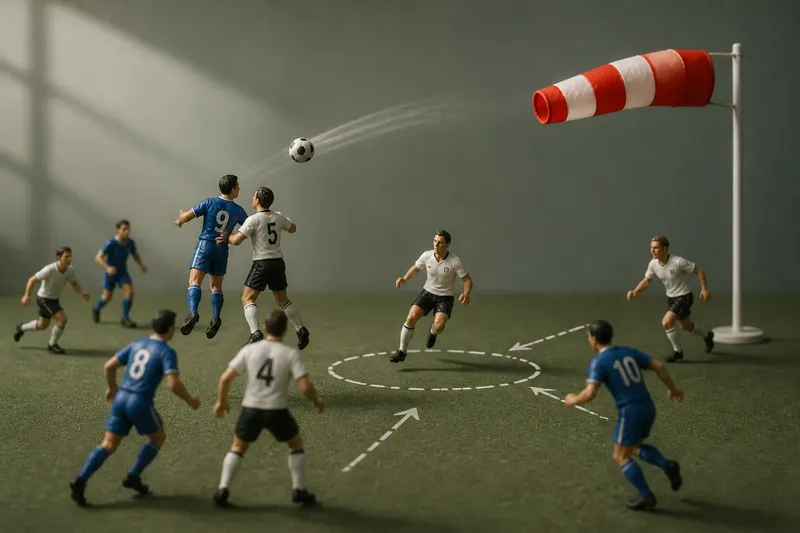
In a windy match, the ball’s landing point can matter more than the pass or clearance that sends it there. To follow the second ball, watch the flight, identify where it is likely to drop, then look for the players moving into that patch of space before the first contest is settled.
What does “second ball” mean in a windy match?
The second ball is the loose ball available after the initial challenge, header, clearance or ricochet. It may fall at a player’s feet, bounce into open space or be knocked sideways by contact. The first player to touch it does not necessarily win the next phase: control belongs to the team that can gather it and make the next useful action.
Wind makes that sequence harder to read because the ball can drift, stall or carry beyond the expected landing spot. A defender may aim a clearance towards the touchline and see it hang in the air; an attacker may judge a dropping ball correctly but meet an opponent first. Keep your attention on the space the ball is entering, not just on the player currently challenging for it.
Where should I look when the ball is in the air?
Start with the ball’s path, then widen your view. Note whether it is moving into the wind, with it or across it, and watch for a change in its pace or direction. You do not need to predict the exact landing point. Estimate a landing area and see which players begin adjusting their runs towards it.
Useful cues include a player slowing down to judge a dropping ball, a teammate turning to face the likely bounce, or an opponent checking over a shoulder rather than following the ball directly. The players who arrive early may have time to brace, call for support or leave room for a teammate to attack the loose ball.
- Follow a high clearance until it begins to drop, rather than switching immediately to the player making the first challenge.
- Notice whether players are moving towards the projected landing area or being carried past it by their momentum.
- Watch the nearest supporting players as well as the aerial contestants; they are often positioned to collect the knockdown.
- After contact, track the ball’s next bounce or deflection before deciding which team has possession.
Which players tend to shape the next contest?
Look beyond the two players contesting the ball in the air. A centre-back may attack the first header while a midfielder waits a few metres behind to collect the clearance. A forward can press that collector, while another attacker holds position to receive a hurried touch. The second contest is often shaped by this supporting group before the ball lands.
Pay attention to body shape. A player facing their own goal may have to control under pressure, whereas a teammate already facing forward can take the ball on and move play towards the opposition. A player standing directly underneath the drop may be vulnerable to a bounce; one positioned to the side may have a clearer route to the next touch.
Say you are watching a match in which a goalkeeper’s long kick is blown towards the left side of midfield. Imagine one team’s centre-forward challenges for the first header while its midfielder waits behind the contest, already facing the opposition goal. If the header drops into that midfielder’s path, watch whether they can collect and release a pass before the defenders recover. The observable clue is not simply who wins the header, but whether the waiting player can turn the loose ball into controlled possession.
How can I tell whether a team is prepared for the wind?
Judge the team’s response across several similar situations, not from one misjudged clearance. Does the side keep a player close to likely knockdowns? Do midfielders move towards the landing area as soon as a long ball is struck? Does the defence leave enough cover behind the first challenge if the ball carries over its intended target?
Also notice how players adjust their decisions. A team may choose a simpler pass when the wind makes a long switch difficult, or use a throw-in to restart play rather than force a risky clearance. These choices are not automatically signs of caution or poor technique. They can show that players are accounting for an uncertain flight and trying to place the next contest in a more manageable area.
Compare the team’s positioning when the wind pushes the ball towards its own goal with its positioning when it is attacking into the wind. The same clearance can create different risks depending on who has space behind the contest and which players can reach the landing zone first.
What questions should I ask while watching?
Why does the ball keep carrying beyond the first challenger?
Wind can keep a ball moving after players expect it to drop, especially when it is travelling high or across the pitch. Watch whether the challenger adjusts their run or remains underneath the original flight path.
Why can a team win the header but lose possession?
A header may only redirect the ball into a space controlled by the opposition. Check where the supporting midfielders are positioned and whether they can reach the next bounce before the other team.
Should I watch the ball or the players around it?
Watch the ball while it travels, then widen your attention to the players gathering around its likely landing area. Once it is touched, follow the loose ball again to see who can make the next controlled action.
Does a long kick always help the team playing with the wind?
No. A kick may travel farther, but it can also overshoot teammates or land where the opposition has gathered. Look for the intended receiver and the nearby players positioned to compete for the next touch.
How does the wind change what a clearance tells me?
A clearance is not just an attempt to remove danger; its destination can set the terms of the next contest. If it reaches open ground, both teams may have to turn and chase. If it drops near a touchline, players have less space to approach from different angles. If it lands among several opponents, the defending team may face another immediate challenge.
Check whether the player making the clearance has a clear target or is simply sending the ball away from pressure. Then follow the players who move towards the landing zone. A useful clearance may give teammates time to push out, while a high ball that falls straight back into the same crowded area can leave the defence under pressure again.
The wind’s direction and strength can vary around a ground, and a sheltered stand may make the ball’s movement harder to judge from your seat. Use repeated flights as your guide: compare the ball’s path over the same part of the pitch and notice whether players are changing their positioning as the match goes on. For decisions that depend on local conditions or competition rules, follow the relevant guidance rather than assuming all grounds behave alike.
What should I track during a spell of repeated long balls?
Look for a pattern in who arrives at the second ball, where it tends to land and what happens next. A team that repeatedly gathers loose balls near the centre may be controlling the space even when it does not win every aerial challenge. A side that keeps knocking the ball into the same wide channel may be steering play towards a particular area, intentionally or otherwise.
Make one simple note during a stoppage: “clearance, landing area, collector, next action”. For instance, you might observe a high clearance, a landing near the touchline, an opposing midfielder reaching it first and a pass back towards the centre. The sequence helps separate the first contest from the possession that follows, without asking you to record every touch.
When you watch a windy match, following the second ball gives you a practical way to read the contest beyond the flight itself. Keep checking where loose balls land, who has prepared to meet them and which team can act after the first challenge. That is often where a scrappy passage becomes a counterattack, a renewed spell of pressure or a chance for the defending side to move up the pitch.